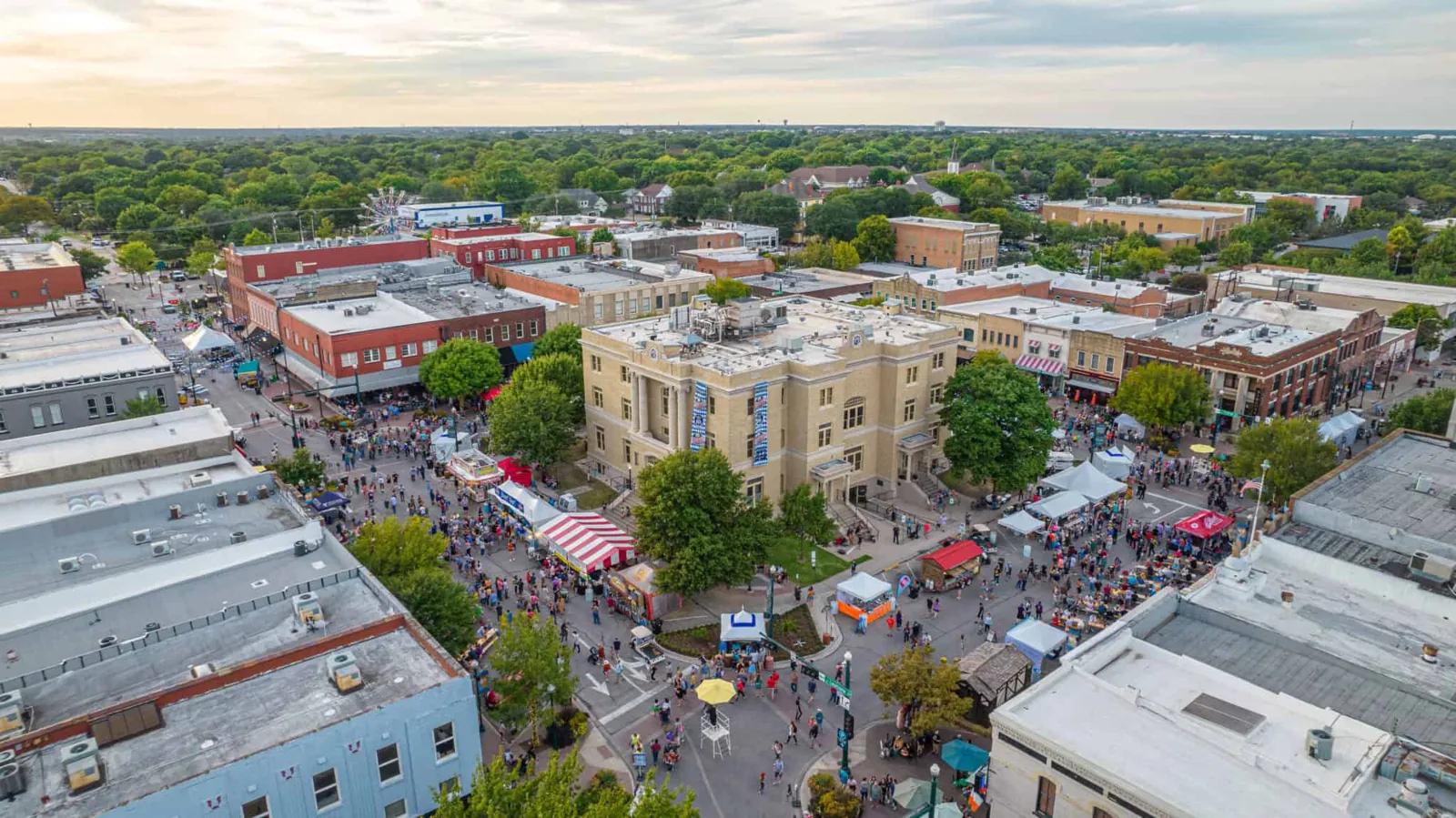
Commercial roofing in the US 75 and SH 121 retail district of McKinney, TX: leak tracing, rooftop unit curbs, loading-zone access, and storm-season repairs.
Tell us about the building and what you are seeing. We reply with the next practical step.
The drip that closes an aisle usually starts somewhere other than the aisle. In a retail district the water enters at a rooftop unit curb, a scupper behind a parapet, or a seam near the loading end, and it travels along the deck before it shows up as a ceiling stain. McKinney, TX lists the US 75 and SH 121 area among its eight high-profile retail development areas, which makes this a district of many properties, many operators, and many different roofs, not a single building. The first check is the same everywhere: find the wet path and follow it back to the closest seam, curb, drain, or transition.
We inspect, repair, and replace commercial roofs across the district. Owners with property in the 121 District or in Allen get the same method. Before anyone prices a scope, we decide where a crew can work without crossing customer traffic or delivery routes, because that decision shapes the repair as much as the leak does. A shopping center roof and a stand-alone retail pad can leak for different reasons and need different access plans, even when they sit a few hundred yards apart.
McKinney describes office and industrial parks throughout the city alongside its retail development districts, and the highway network of US 75, SH 121, and US 380 ties those uses together. A roofer working near the intersection of the first two routes should expect to move between very different assemblies in a single week. A strip of storefronts often carries a continuous low-slope membrane with several shared drains. A larger retail building may have a deck with long runs, many rooftop units, and a parapet that holds back water during heavy rain.
We do not assume a roof type from an address. On the first walk we identify the membrane, the insulation layer if it can be read from the surface or the core, the fastening pattern at the edges, and the flashing details at every wall. Those observations tell the owner whether a patch holds, whether a recover over the existing roof is realistic, or whether wet insulation means a full tear-off.
A store with a daily delivery window has an hour or two when the back of the building belongs to trucks. Roofing staged in that same area competes with the trucks, and the crew loses. We plan the staging area so deliveries keep moving: the lift goes where a trailer does not need to back, and the tear-off debris chute drops into a closed container away from the dock.
Roof access is a second question. Some buildings have an interior ladder and a hatch. Others need a ladder on an exterior wall, and a few need a lift to reach a parapet. We confirm the route up and the tenants whose space sits under the work zone. When the work happens over an operating retail floor, we also agree on how an occupied building is protected, including debris control, noise windows, and the areas inside that must be cleared before demolition starts.
Retail and office buildings put a lot of mechanical equipment on the roof, and every unit is a hole that someone flashed by hand. Curb corners, pipe boots, and the seam where membrane meets the curb wall are the weak points we check first. Heat drives the movement there. Weather Service normals for the Dallas and Fort Worth region put summer highs close to 96 degrees, and a membrane that cycles between that surface heat and a cool night keeps stretching the same few inches of flashing. Over a few summers that movement opens a pinhole, and the pinhole becomes the leak that gets blamed on the last storm.
When a curb is failing, the repair boundary matters. A new curb or equipment support is coordinated with the mechanical contractor so the unit can be lifted, the flashing rebuilt, and the unit set back in one visit, scheduled around operating hours.
Spring is the severe-weather peak for the Dallas and Fort Worth area, and the Weather Service lists tornadoes, flooding, damaging wind, and large hail as yearly events somewhere in the Metroplex. That is regional context, not a statement about any one roof in the US 75 and SH 121 district. It does tell a property owner when to look: after a spring hail event, the soft spots on a membrane, the bruised insulation under it, and the debris packed into drain sumps are the items we check, and we photograph each one so a carrier or an owner can see what was found.
The same service lists about 37 inches of annual precipitation for the region, with May alone averaging nearly 5 inches. A flat retail roof with a sluggish drain will hold water for days after a May storm, and standing water finds every weak seam. Clearing the drain path is the cheapest repair on the roof, and it is the first one we recommend when we find ponding water on a district roof.
Among McKinney's adopted codes are the 2024 International Building Code with local amendments, along with the 2024 energy conservation, existing-building, and fire codes. A repair that stays inside the existing roof assembly may need little more than a notice, while a replacement or a change in insulation thickness can trigger permit and energy-code review. We ask the building official about the specific scope before a bid goes out, so the owner is not surprised by a requirement after demolition has started.
At closeout we hand the facility director a record that says what was opened, what was dried, what was patched, and what was left for a later budget year. Photos of each repair location, a marked roof plan, and a short list of items to watch go into that file. A written condition report built from the same walk gives a property manager something to attach to a lease file or a capital request.
Share where water shows inside, the hours the building is open, and any limits on roof access or the loading area. We will sequence the inspection around the workday and return a repair boundary with a plan for the work zone.
Short answers to what owners and facility managers ask before a roof visit.
Retail buildings, office buildings, and the light-industrial or flex space that sits among them. McKinney identifies the district as a retail development area and lists office and industrial parks throughout the city. We treat each property on its own roof type, access route, and operating schedule, and we do not apply one scope to a whole row of buildings.
In most cases the dock can keep working if the staging area, lift position, and debris container sit away from the truck court. We mark those locations on the plan before the crew arrives. When a crane pick has to cross the dock, we schedule it for the quietest delivery hour and hold the lane clear for that window only.
Usually a stain or drip that lines up with the unit's position on the roof but lands a few feet away, because water follows the deck or a duct before it falls. We start at the curb and the nearest seam, then check the refrigerant lines and condensate drain. Moisture scanning confirms how far the wet area has spread.
Soon enough that the photographs and measurements are still tied to the storm date. Fresh impacts, torn flashing, and dislodged coping are easier to document in the first few days, and a carrier will want that record. A roof that has been wet for weeks may also need an infrared survey to find trapped moisture.
That depends on the scope. McKinney adopts the 2024 building and energy codes with local amendments, so a full replacement or a change to the insulation layer is the kind of work to confirm with the building official. A like-for-like patch normally needs far less. We check before pricing, not after the tear-off.
Send a question about the building and we will reply. Or call 555-555-5555.