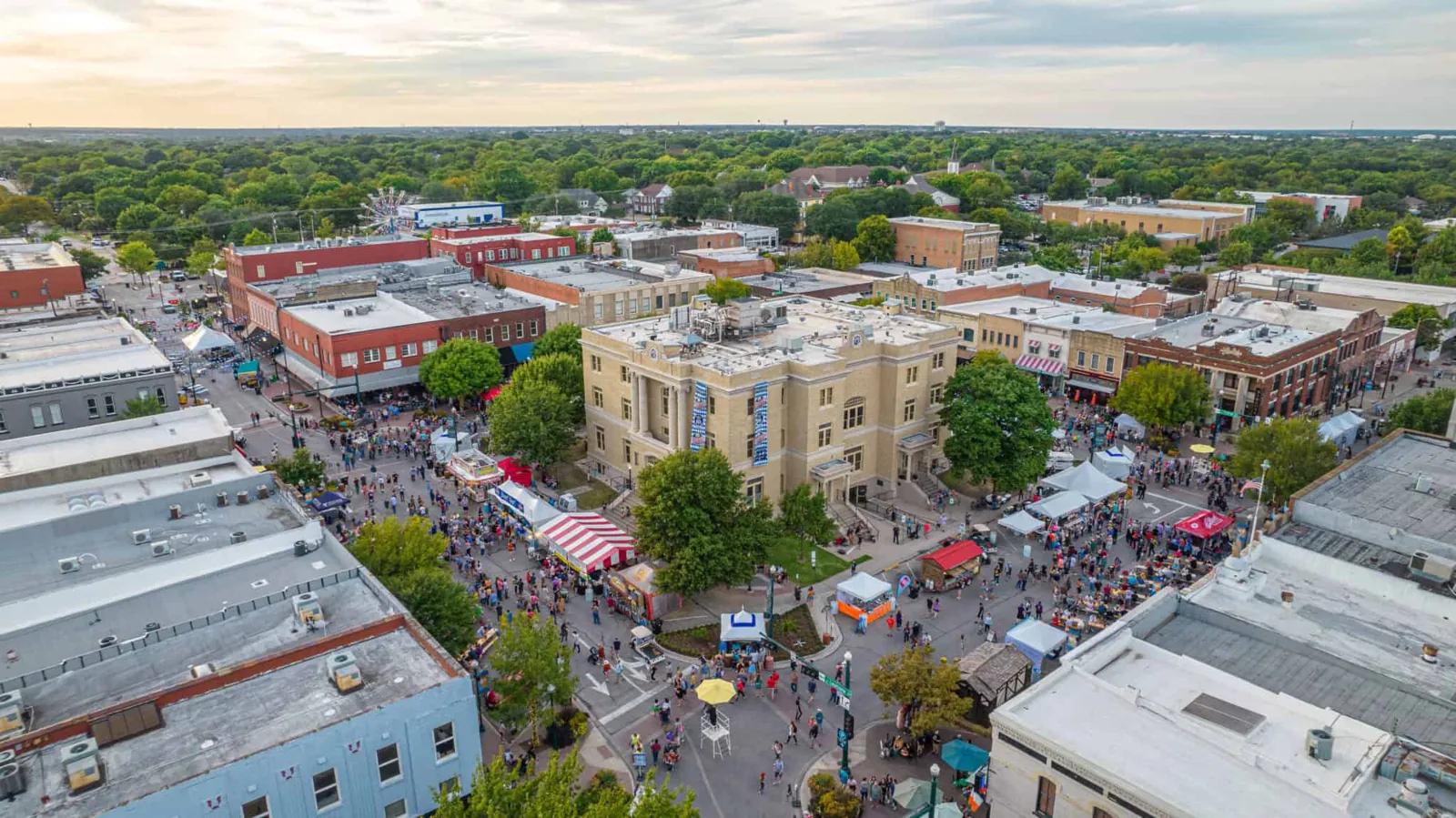
Commercial roof repair, replacement and storm response along North US 75 in McKinney, TX, with lift, delivery and staging plans set before the crew arrives.
Tell us about the building and what you are seeing. We reply with the next practical step.
The hardest part of a roof job on a highway frontage is often the truck, not the membrane. A delivery of insulation board needs a turning radius, a lift needs firm ground, and a crane needs a clear swing, so the first check along North US 75 is the approach to the building and the place where equipment will stand. McKinney, TX lists North US 75 among its eight high-profile retail development areas, and the city's office and industrial parks sit on the same highway network. We plan the lift and the staging area first, then the repair boundary.
Roofing material is bulky. A single reroof can bring pallets of insulation, rolls of membrane, adhesive drums, edge metal and a dumpster, and each piece needs a place to land. We walk the site to locate the drive that trucks will use, the ground where a lift or crane can stand, and the nearest area for staging that does not block a fire lane or customer parking.
McKinney describes access to US 75, Sam Rayburn Tollway and US 380 as serving its office, industrial and retail areas, and says the city sits within about thirty minutes of Interstates 20, 30, 35 and 635. That reach helps with material supply, yet the last few hundred feet depend on the property itself. Freight, lift and crew routing still turn on the building's real approach and any restrictions on it, so we confirm those with the owner or the property manager before a delivery is booked.
For buildings with shared drives, we coordinate with neighboring tenants. A morning delivery that arrives while a competitor's trucks are queued at the dock turns a short unload into a delay for everyone.
The city's own materials describe office and industrial parks across McKinney and retail districts along the highways, so a stretch like North US 75 can hold more than one building type. We do not assume which type a given roof belongs to. The first walk establishes it and our report says it.
If the building is an office, the concern is usually the space below: finished ceilings, carpet, servers and people. Leaks over office space call for quick isolation and a clean, quiet repair. If the building is industrial, the roof is often larger and more open, with exhaust, skylights and dock-area edges to check, and the production floor below may carry its own water-sensitive equipment. If it is retail, customer hours set the window.
Each case gets its own sequence. An office building job puts noise and dust first, a flex industrial job puts dock activity first, and a shopping center job puts customer paths first.
Larger low-slope roofs accumulate wear unevenly. Seams along the prevailing weather side age faster, drains at low points collect debris, and edge metal at the perimeter takes wind uplift first. We look for lifted laps, split seams, blistered or alligatored surfaces on older built-up and modified bitumen roofs, and shrunken or pulled-back flashing at walls.
Fasteners in metal roofs can back out with thermal movement, and sealant at laps dries and cracks. On those roofs, we check each penetration and the closures at ridge and eave. For metal panel buildings, a metal roof retrofit can add a new weathering layer over sound framing without removing the existing panels.
Moisture again is the hidden problem. Wet insulation does not announce itself, and a roof can look intact over a saturated layer. An infrared moisture survey outlines wet areas so that the tear-off limit is a line on the plan rather than a guess. On a large roof that line matters: removing every layer when only a third is wet doubles the open-roof exposure and the disposal load, while leaving wet insulation in place just moves the leak a few feet.
Timing on a highway-frontage roof follows three things: the operating hours of the building, the weather, and the lead time on materials. We set a work window with the owner, then watch the forecast daily. Regional normals for Dallas-Fort Worth show about 37 inches of annual precipitation and a wet May, so a weather hold is part of every schedule, not an exception.
Cost moves with the amount of wet insulation, the count of layers, the deck condition, the number of penetrations, the length of edge metal and the share of work done after hours. Access by crane or lift adds a line of its own. We list each driver in the scope, with a repair option and a replacement option side by side, so the owner can see what each choice covers.
Where the roof is dry and the structure sound, a recover over the existing system may shorten the time a building is open to weather. Where wet material is widespread, replacement is the scope that holds up.
Storm season peaks in spring in Dallas-Fort Worth, and the Weather Service notes that large hail, destructive wind, flooding or a tornado lands somewhere in the Metroplex nearly every year. One regional season is no verdict on a particular North US 75 building, so we inspect before drawing a conclusion and record what we find with dates and photographs.
If a roof opens during a storm, emergency response runs overnight and on holidays. The crew finds the entry point, places a temporary cover and logs what was done, leaving permanent work for a planned visit. Our emergency roof repair notes are written so that the later repair starts where the first stopped. Large roofs also collect debris after wind, so the first daylight visit includes a walk of every drain and scupper, since a clogged outlet during the next rain turns a minor repair into a flooded corner. Edge metal and coping that lifted in the wind are re-secured the same day, because an open edge is the way a gust gets under a membrane.
North US 75 runs toward the US 75 and FM 543 area, and an owner with properties in both can keep one maintenance calendar. Nearby Allen raises the same drainage and storm questions, and owners toward Historic Downtown McKinney face a different set of access limits that we plan separately.
Tell us where the roof is reached, where trucks can stand and which area is leaking. We will plan the inspection around the building's workday. Start from the contact page.
Short answers to what owners and facility managers ask before a roof visit.
The truck route, the turning room, the ground where a lift or crane will stand, and the place where pallets will wait. We confirm all four with the property manager before booking material.
Office roofs put the weight on isolation and quiet, because of finished space below. Industrial roofs tend to add dock edges, exhaust and skylight curbs to the checklist.
Only where the existing insulation is dry and the structure can carry the extra layer. A moisture survey answers the first question, and a structural review answers the second.
The property manager does, with neighboring tenants if the drive is shared. We map the swing and the ground conditions and send them for approval.
The entry point, what was opened and dried, the temporary cover and what remains. That record guides the permanent repair.
Send a question about the building and we will reply. Or call 555-555-5555.