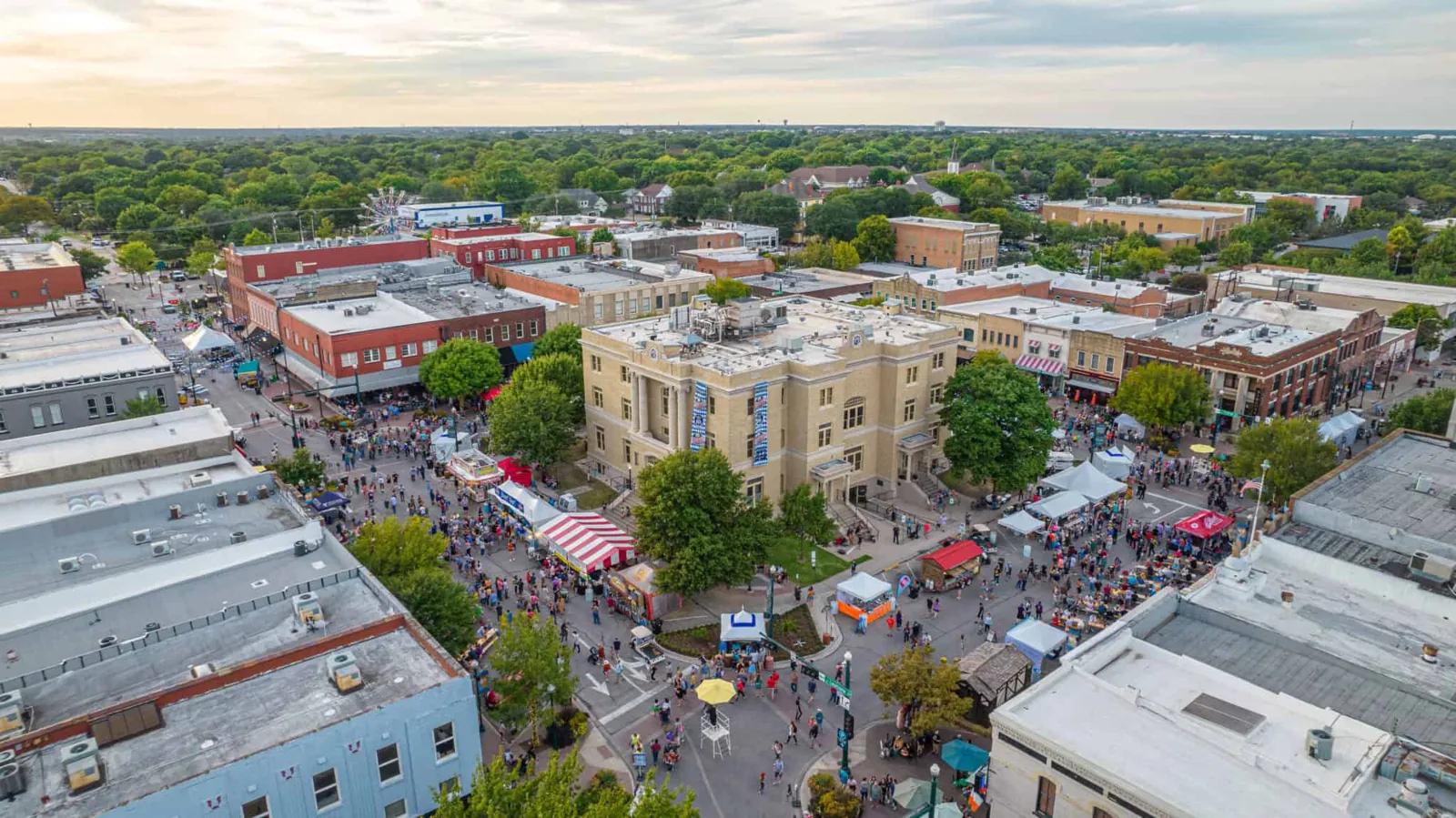
Commercial roofing in Celina, TX: early roof records for growing commercial areas, US 380 access planning, closeout defect checks, and storm-season inspection.
Tell us about the building and what you are seeing. We reply with the next practical step.
The first leak on a recently built roof usually traces to a detail that nobody closed out: a drain bowl with a gap at the clamp ring, a flashing that stops short of its counterflashing, a rooftop unit set by a later trade with no roofer present. Celina places its commercial geography on the ground from Preston Road out to the future Dallas North Tollway, and it names US 380 and other arterials as growth corridors. For a Celina, TX building in that setting, the first check is the closeout record: what was installed, what was inspected, and what was never written down.
Celina sits about 11.5 miles from McKinney by straight line, well inside our service radius. We inspect, repair, and replace commercial roofs there, and each visit starts by finding where the water enters and drawing the repair boundary around that point.
Where roofs are young, the paperwork usually still exists. We ask for the specification, the warranty, the as-built roof plan, and the installer's contact. Then we walk the roof against those documents and note every difference: a curb in a different place, a unit that was not on the drawings, a drain with no strainer.
That first walk becomes the baseline. Each later visit uses the same photograph positions and the same checklist, so a change shows up as a change and not as an opinion. A written condition report built this way is what a property manager hands to an owner, a lender, or a manufacturer when a question comes up, and it costs far less than reconstructing the history after a leak.
Drains deserve a place in that baseline. We count outlets, note the strainer type, and photograph each drain and scuppers position, so a missing strainer or a blocked outlet shows up as a change from the first visit.
Photographs in the baseline are tied to roof-zone numbers, so any later reader can find the same spot. That sounds small, but it turns a stack of pictures into a usable history.
Celina's planning materials tell us where commercial and employment growth is expected, and they say nothing about what any one roof is made of. So the work plan begins with the roof plan, the access gate, and the delivery route, and a crew day is assigned only after those three are in hand.
Where construction is ongoing nearby, access can change week to week: new curb cuts, closed lanes, and shared construction traffic. We confirm the approach the day before and again that morning, and the work plan names an alternate staging area. A lift that cannot reach its position costs the same as a lift that can, so the route is checked before the crew rolls.
Planned tollway frontage will change traffic and site layouts over time, and roofs on new buildings should be recorded with that in mind. A parapet height, a screen wall, or a rooftop unit added later alters drainage and access, and the record notes the date and the reason for each change.
Defects in young roofs have a pattern. Terminations that were sealed but not mechanically fastened loosen with the first hot summer. Drain strainers go missing after a trade cleans the roof. Walk pads are left off paths where service staff walk daily. Sealant at curb corners was applied in cold or damp conditions and never cured fully.
We walk for each of those, photograph the finding, and send it to whoever is responsible for the work. A repair made in the first year, under the right party's responsibility, is cheaper than the same repair after a storm exposes it. For a building with a warranty, the report also protects coverage, since the manufacturer will ask when the defect was found and what was done about it.
A TPO or other single-ply seam deserves a probe in the first year. A cold weld looks fine and holds until the roof heats and cools a few dozen times. Probing a sample of seams, starting with T-joints, is a short job that finds the problems while the installer is still responsible.
Edge metal gets a hand test: grip the coping, pull, and watch for movement. A coping that shifts under a hand will shift under wind, and the fix is cheap before a storm and costly after.
Climate normals for DFW list July afternoons at 95.6°F on average and August at 95.8°F. On a roof only a few seasons old, that heat is when weak terminations show themselves: a bead of sealant that never cured, a seam probed too early, a strip of edge metal pulled loose by thermal movement. We schedule membrane handling for the early shift, because a sheet laid on a hot surface relaxes and wrinkles before it can be welded.
The same Weather Service narrative calls spring the severe-weather peak for the Metroplex, when tornadoes, flooding, wind damage, and large hail turn up somewhere in the region in nearly every year. A regional season says nothing certain about one Celina roof. After a storm we walk the zones, photograph any impact marks or lifted edges, and log drain condition, so a hail damage repair begins from dated evidence and not from a guess.
Between storms, a preventive maintenance pass is the cheap step. Clearing strainers, resealing a cracked boot, and rechecking the work of trades that visited the roof since the last walk keeps a young system from picking up wear it does not need.
The repair boundary says what is being fixed and what is left alone. A flashing repair at one curb stays contained. Wet insulation across a zone is a larger scope. If the roof carries a manufacturer warranty, the repair method follows that document, and the warranty file shows who did what and when.
The closeout record lists what was opened, dried, patched, and left for follow-up, with photographs by zone. Neighboring Prosper and Melissa properties go through the same open, dry, patch, and record steps. Code editions and local amendments differ by municipality, so a Celina replacement or recover is confirmed with the Celina building official before the design is fixed.
Cost and timing follow a short list of drivers: the size of any wet area, the number of curbs and penetrations to rework, access for a lift, the hours the building allows, and whether the deck needs repair. They are stated in the scope with measured quantities so options can be compared on the same basis.
Tell us where water shows, when the building runs, and which gates or lanes are off limits. We will sequence the first walk around that workday and return a repair boundary with a work plan.
Short answers to what owners and facility managers ask before a roof visit.
About 11.5 miles by straight line. Drive time depends on the route and the day, so scheduling starts from the building's access window rather than from the mileage.
Yes. A first-year walk catches unsealed terminations, missing strainers, and penetrations added after install, and it starts the record that supports a warranty claim later.
The leak location, operating hours, and access limits. Roof plans, warranty papers, and repair history help, along with any equipment changes since the roof was installed.
Usually. We divide the roof into zones, set access, isolation, and overhead protection first, and open only what can be closed the same shift. A zone above equipment that cannot be disturbed moves to an agreed window.
Dated photographs of impact marks, lifted edges, and drain condition by roof zone, with findings stated without assuming damage. The record stays with the roof file.
Send a question about the building and we will reply. Or call 555-555-5555.