Government and municipal building roof repair and replacement in McKinney, TX, with written scopes, adopted code review, access control and closeout files.
Tell us about the building and what you are seeing. We reply with the next practical step.
Water over a records room, a council chamber or a dispatch console is a service interruption before it is a roof problem. A public building has hours, security checkpoints and visitors who cannot be turned away at the door, and a roof crew has to fit inside that structure. We begin at the interior location, trace the wet path to the seam, curb, drain or parapet that feeds it, and write a repair boundary a facilities manager can attach to a work order. For a municipal or county building in McKinney, TX, the written scope matters as much as the repair, since someone will need to approve it, fund it and file it.
Public owners buy against specifications, quotes and board approvals. A vague estimate stalls at that stage. We write the scope so each line is something a reviewer can check: the area, the system, the tear-off limit, the edge details, the drainage corrections and the closeout items. Alternates are priced separately, so the owner can choose between a repair, a recover and a replacement without redrafting.
We also state assumptions that could change the price, such as wet insulation found after the first cut or a deck that needs replacement under the opening. Unit pricing for those items is listed in advance, which lets the owner approve a change order quickly instead of reopening the process. The aim is a document that moves through review without a second round of questions.
Bid timing deserves attention. Roof prices move with material lead times, and an approval that sits for weeks may need a refreshed quote. We state how long the pricing holds and what moves it, so the board knows the deadline before the meeting, not after.
The city's adopted set includes the 2024 International Building Code with local amendments, the 2024 International Energy Conservation Code, and 2024 editions of its existing-building and fire codes. A roof scope on a public building touches several of them: insulation values, fire ratings, wind uplift at edges and the treatment of existing layers. The required set depends on the permit, so we confirm it with the building official before material is ordered.
Energy code questions come up often. Adding or replacing insulation can change the required R-value, and a recover may or may not satisfy it. We name the question in the scope and the owner's code consultant or the building official answers it. The insulation and cover board layers chosen at that stage are design choices, not surprises at inspection.
Many government buildings control entry. Courthouses and police facilities screen visitors, records rooms are restricted, and some roofs are reached only through secured stairs or mechanical rooms. We ask the facilities lead who must escort the crew, what identification is required, which tools and materials need inspection at the door, and whether any area is off limits.
The work zone keeps public paths open. Staging goes on a service side or a lot corner, and a barricade and spotter protect the walkway under any lift. Crew members arrive at agreed times, sign in and carry badges when required, so security staff know who is on the roof. Equipment such as cameras, antennas and communications gear is located and protected, and we do not move it without the owner's technician.
Roof drawings and equipment lists sometimes sit with the owner's engineer or a separate security office. We request them early, because a missing drawing can delay the start more than weather does. Where the building has rooftop cameras or antennas, the owner's technician disconnects and reconnects them, and we log the time each one was out of service.
Some rooms cannot go dark: dispatch, emergency operations, server closets, court recording and the clerk's counter. For those, we ask what protection is needed and how long a ceiling opening can last. Temporary dry-in, interior sheeting and a monitor in the room during rain keep service going while the permanent work proceeds.
Planning around meetings matters too. A council chamber used on a regular evening needs its roof zone finished and swept by the afternoon, and a courtroom may need a quiet day. We schedule noisy tasks away from those events and agree on a stop time for each day. If a storm threatens, the open area is sealed and the crew leaves, so the next morning starts dry.
Records rooms need a particular approach. Paper does not tolerate moisture, and a small leak can ruin years of filings. We cover shelving with sheeting before opening anything above, and the clerk or records manager decides what must be moved first.
Afternoon normals climb to 95.6°F by July and 95.8°F by August, and spring is the stretch when hail, damaging wind, flooding and tornadoes strike the Metroplex most often. Neither of these events proves damage to a particular roof. A building owner who has a record of condition, though, can compare a roof before and after each season and act on the difference.
We build that record: dated photographs, drain checks, notes on penetrations and a short ranking of urgent and later items. A roof condition report becomes the baseline for budgets, and a warranty file keeps manufacturer paperwork with the building rather than with a retired staff member.
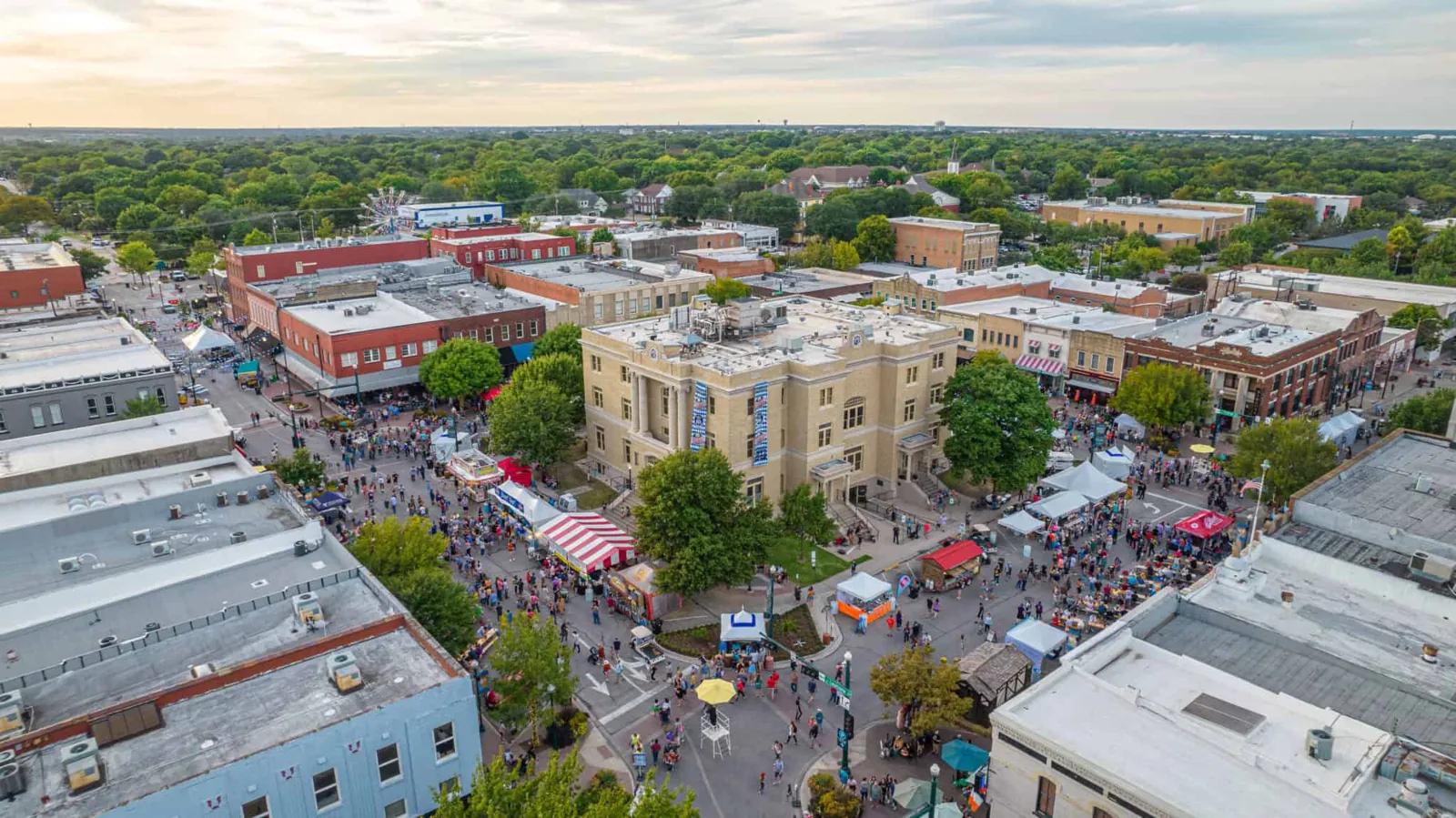
Public buildings in McKinney sit in very different settings. The city lists Historic Downtown among its eight high-profile retail development areas, and it separates older storefronts from larger retail properties when setting roof access and phasing. A public building near Historic Downtown therefore tends to need tighter staging and smaller phases than one along US 75 and FM 543. The Historic Downtown McKinney and US 75 and FM 543 areas mark the two ends of that range.
Public agencies often manage several buildings at once, and a public agency can bundle roofs into one program. The same closeout format supports a school building and a storage facility, so a facilities department can compare roofs across its portfolio and set priorities by condition, not by complaint.
Parking structures, maintenance yards and fire stations belong in that comparison. A fire station runs around the clock, so roof work there is staged by bay and shift, and the apparatus doors stay clear. A maintenance yard may hold fuel, salt or equipment under the work zone, and we ask what is stored below before choosing the method.
Share where water appears, who escorts roof entry and how the work must be approved. We will write the scope and sequence the inspection around the public schedule.
Short answers to what owners and facility managers ask before a roof visit.
The area, system, tear-off limit, edge details, drainage fixes and closeout items, with alternates priced separately and unit prices for hidden conditions.
We agree on escorts, identification and tool checks with the facilities lead. Crew members sign in, wear badges when required and stay in the approved work zone.
Yes, with interior protection and a monitor in the room. We seal the opening at day's end and avoid noisy tasks during hearings or calls.
The city's adopted building, energy, existing-building and fire codes, in their 2024 editions with local amendments. The building official confirms the set for each permit.
Photographs by zone, material data, drain and flashing checks and warranty paperwork, written for the next facilities manager.
Send a question about the building and we will reply. Or call 555-555-5555.