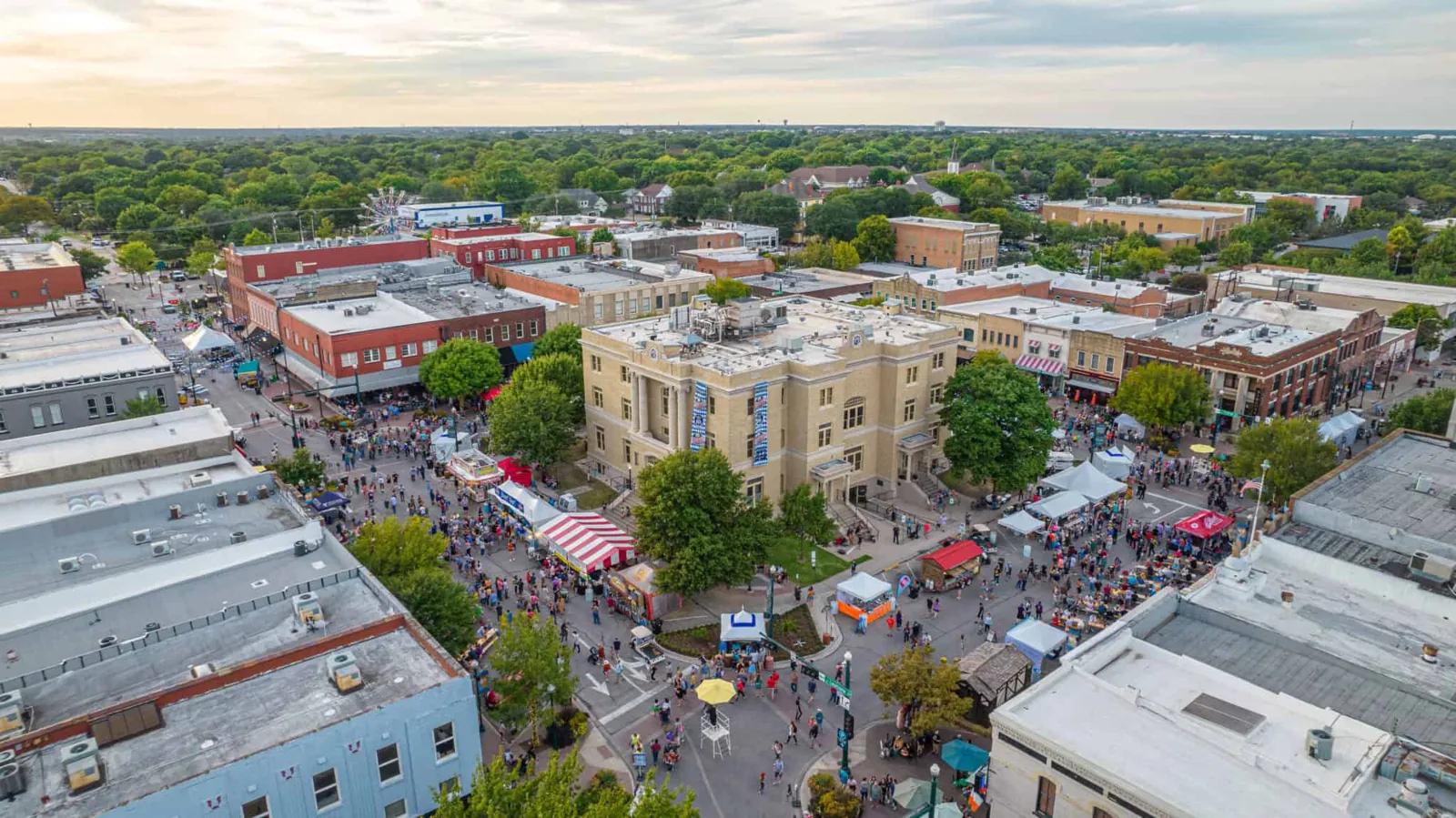
Big-box store roof repair, recover and replacement in McKinney, TX, with quadrant by quadrant phasing, night work options and drone surveys after storms.
Tell us about the building and what you are seeing. We reply with the next practical step.
A bucket in the middle of a sales aisle is the visible end of a long path. On a big-box store the water may enter at a parapet corner, run along a deck flute for a long stretch, and finally drop beside a display the manager cannot move. We trace backward from the drip, find the seam, curb or drain behind it, then set the repair boundary before a lift touches the store. A big-box roof in McKinney, TX also has to be worked while the doors stay open, so the first question after the location is always which quadrant of the roof can be isolated first.
A large store cannot close for a roof job. We divide the roof into work zones, usually by drainage area, and open one at a time. Each zone is torn off, dried in and sealed before the next is touched, so no part of the sales floor sits under an open deck overnight. If a storm threatens, the open zone is secured with a temporary edge seal and the crew stops.
The order follows leak history and drain paths. A zone feeding a known problem goes first, and the zone above the receiving dock follows, since a wet dock slows deliveries as well as sales. Staging goes where trucks do not run: a rear corner of the lot or a side lane, with a lift plan that raises material before opening hours.
Interior protection goes up before the first cut. Plastic sheeting and temporary ceiling guards sit below the work zone, and a monitor checks the sales floor for drips during and after each shift. If a store carries food or pharmacy stock below the zone, we agree on a cover plan with the manager first.
Large-format retail roofs carry a crowd of rooftop units, condensers, exhaust fans and conduit runs. Service technicians cross the membrane to reach them, usually with tools and sometimes with parts, and foot traffic is a leading cause of punctures at the paths between units. We check the lines technicians walk most and recommend equipment curbs and supports that raise piping and conduit off the surface.
Walkway pads protect the membrane under those routes, and they are cheap compared with a recurring leak near a unit that runs all summer. When a unit is replaced, the old curb adapter or a new curb needs its flashing redone, not just the unit set down on it. We coordinate crane time with the mechanical contractor so the unit and the flashing are finished in one visit.
Wind lifts a roof from its edges, and on a wide, low-slope store the perimeter and corners take the most load. Edge metal and coping that have loosened are the first point of failure, followed by the membrane they hold down. After a spring storm, we walk the perimeter, check fasteners and cleats, and look for gaps where wind-driven rain can enter.
The National Weather Service places the Metroplex's severe-weather peak in spring, when hail, wind, flooding and tornadoes show up nearly every year. A store along US 380 or US 75 sees the same weather as a store anywhere else in the region, but the roof reads it differently depending on how the edge is built. A wind damage repair starts with edge metal, then moves inward along seam lines.
Edge repair is also the cheapest place to buy time. Re-fastening a coping run, replacing a torn cleat and resealing a corner can hold a roof through the next storm while a larger scope is priced. We label those fixes as temporary in the report, with the date and the location, so the next visit starts where the last one stopped. Rain-driven water at a corner shows up as staining on the inside of the parapet wall, and that stain is the clue that sends us to the corner flashing first.
Walking every square of a large roof after a hailstorm takes days and misses things. A drone roof inspection moves across the field quickly, flags impact marks and ponding, and tells the crew where to spend ground time. Infrared imaging adds moisture patterns once the roof has dried and the sun has dropped.
Hail leaves bruises that do not always leak at once. The survey separates a few fractured spots from a general pattern of damage, and that difference decides whether the store needs a repair crew, an adjuster or both. A dated photograph set by zone gives the retail owner a file for the insurer, and it keeps the claim from turning into a debate about what was there before.
McKinney lists eight high-profile retail development areas, and three of them meet US 380: Custer Road, Lake Forest Drive and Hardin Boulevard. A store in the Lake Forest Drive and US 380 district and one in Historic Downtown need different plans, because the city itself separates the access and phasing needs of an older storefront from those of a larger retail property. A large store gets zone-by-zone phasing and a crane pad; a downtown storefront gets smaller phases and tighter access.
The city also points to US 75, SH 121 and US 380 as the principal highways, with interstates within about thirty minutes, which helps material delivery. Property-level truck access, staging and roof access still have to be confirmed on each site, so we walk the lot with the store manager and the receiving lead before setting the lift plan. Roof hatch location, ladder reach and the position of fire lanes decide where the crane can stand.
Where a store shares a lot with other tenants, the lot owner may need to approve a lane closure. We ask early, because a permit or a lease clause can move the start date more than the weather does.
Regional chains want the same answer from every store: what is wrong, what it costs to correct, and when. A written scope gives that, listing the tear-off limit, the system, the edge details and the schedule. For a store with dry insulation, a recover avoids removing the old membrane and the disposal it requires. When water has reached the deck, tear-off is the better choice.
The closeout record covers photographs, seam checks, drain paths and materials. A retail chain with many stores uses those records to compare condition and plan its budget across locations. A neighboring grocery store or a warehouse yields a record in the same format.
One more item belongs in that file: the weather hold log. Every day the crew stopped for rain, wind or heat is written down with the zone that was open, so the store can see how each decision protected the sales floor.
Share where water appears, when the store opens and closes, and where trucks can stage. We will set the inspection and the first work zone around the sales floor.
Short answers to what owners and facility managers ask before a roof visit.
Yes, in phases. Each zone is torn off and dried in before the next opens, with noisy or fume-heavy work scheduled for early hours.
Water runs along the deck and through insulation before it drops. We trace it back along the slope to the seam, curb or drain where it entered.
Walkway pads on the routes to each unit, plus raised supports for piping. We mark the busiest paths during the first walk.
As soon as it is dry and safe to access. A drone pass can be done within a day, and ground checks follow on the zones it flags.
Overtime and lighting add to the price, but they can avoid lost sales and customer complaints. We price both ways when the store asks.
Send a question about the building and we will reply. Or call 555-555-5555.